
Mathematical modelling represents a real-world system. Often the goal is to understand the causes of observed phenomena by identifying key variables and causal relationships. With a tailored model, one can simulate alternate scenarios to predict future outcomes, or optimise strategies where it would be unethical to test in real life (such as in health care).
A delicate balance
A good mathematical model should provide just the right amount of information. There is a temptation, especially with the computing power available today, to add more and more until you’re adding the location of Jupiter. But when there’s a lot of input, the output can be challenging to disentangle. Moreover, complex models can be slow to run on a standard laptop, thus limiting the range of alternate scenarios that can be readily predicted. This may be especially relevant during the initial construction phase, where many simulations are needed to verify the model.
Dancing with experts
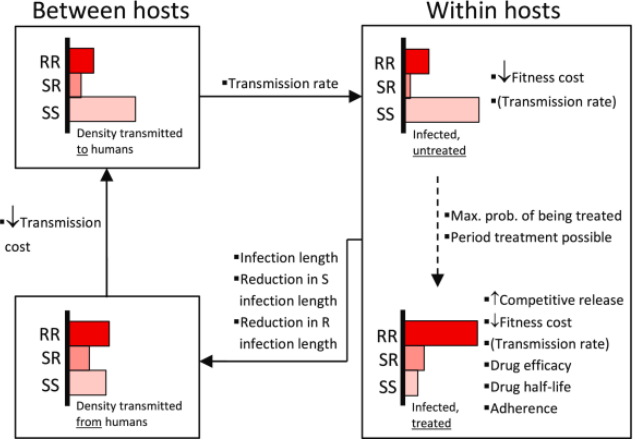
The beauty of developing a mathematical model with experts lies in the inspiring discussions. I learn about the key features and dynamics, while the experts are challenged to view their work from a fresh perspective. Then an initial model is created, which should be as simple as possible whilst capturing the dynamics of interest. The development from this initial model to one that meets the task is an iterative process. Guidance is provided via feedback where possible, but crucially the output from the model should reproduce the observed phenomena identified during the learning phase. For example, when modelling drug resistant malaria, I was told that drug resistant malaria has been observed in areas of low transmission first. Therefore, any model I created that didn’t capture this observed phenomenon was unsuitable, and additional modifications were necessary.
If you wish to collaborate with building a mathematical model, please contact me on LinkedIn. I have experience in compartmental models, agent-based models, spatiotemporal models, game-theory, and fluid flow.


 Tamsin E. Lee