
How much time is needed to get over someone? To answer that question, we need a tool that reveals the healing process of the heart: a broken heart barometer! So I offer such a tool in the form of this basic spreadsheet.
To begin, let us define what “getting over someone” actually means. Assuming, that you can only be in love with one person at a time, let us define “getting over someone” to be the period of time between the end of one relationship, and when you’re ready to fall in love again.
Years together (cell B5)
I’ve heard a basic rule of thumb that this takes twice as long as your relationship. I don’t believe this to be true because we interpret time on a log scale. That is, the additional year in a relationship from 2 to 3 years is more significant than an additional year for a 20 year relationship. So let us improve upon this basic linear model by stating that the basic healing time is on a log scale, and while we’re at it, let’s add some upper and lower bounds.
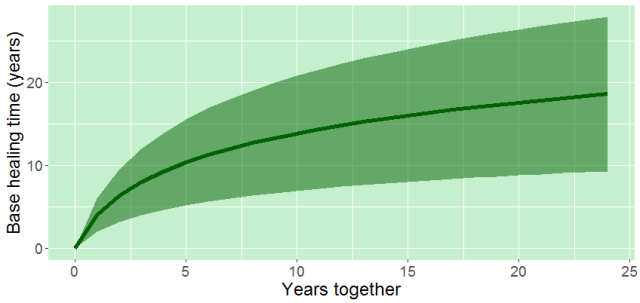
Notice that this is very pessimistic, more pessimistic than it taking half the time. However later we’ll see that this reduces when one considers the quality of the new beau or belle lined up in your life.
But before we think about this new venture, we discuss other factors that affect the time taken to heal. Now each broken heart is individual, so instead of trying to capture everything, I’ve focused on three universal factors.
I will now describe these three factors, and how I assume they affect the healing time. However, I’m open to your opinion about how these factors affected you should you be willing to share.
1. Contacting your ex (cell B6)
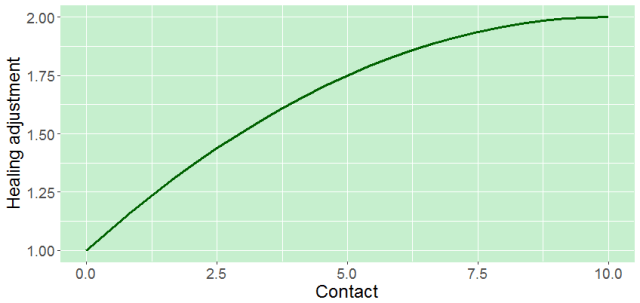
I assume that if you contact each other several times a day then it will take twice as long to heal. But the difference between contacting each other daily to several times a day, is minimal. And at the low end of the scale, increasing contact from never to approximately once a year, has a greater effect.
To help you apply the model to your situation, I suggest the following guide: 10 is more than once a day, 9 is daily, 8 is 5-6 times a week, 7 is 2-4 times a week, 6 is once a week, 5 is once every two weeks, 4 is once a month, 3 is once every three months, 2 is once every 6 months, 1 is once a year, and 0 is less than once a year.
2. Lack of distractions (cell B7)
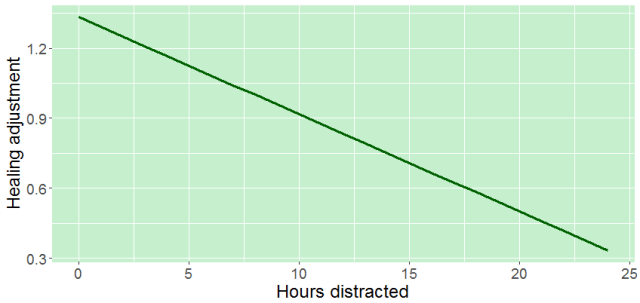
How many hours a day are you left to ruminate? I’ve assumed the effect is linear. That is, the effect of an extra hour of distraction during the day is equally important, no matter whether you’re already very distracted or it’s your only hour distracted. The function is set so that 8 hours a day is average. Less than 8 hours means that you’re loosing sleep and sadly, it will lengthen your recovery time. More than 8 hours will reduce your recovery time. Hopefully, this will encourage you to take up a new hobby and reduce those sad hours!
3. Victimisation: How much control you had over the break up (cell B8)
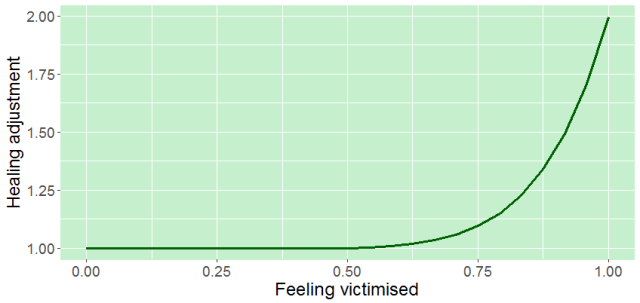
I understand that this is difficult to quantify. Perhaps your ex committed an act that you can’t tolerate. Under this circumstance, do you have the control? So for this factor I would suggest you think about whether you feel you have the control, or whether you feel the break up was inflicted upon you. If it was totally your decision, then your victimisation factor is 0, whereas 0.5 means that it was a mutual agreement. It is assumed that anything between these two scenarios has an equal affect on your healing time. But once the situation is one where you feel victimised by either your partner or the world, then healing becomes more difficult. The maximum is 1 which corresponds to a situation where you were dumped apparently out the blue, or your loved-one died unexpectedly.
The quality of your new partner
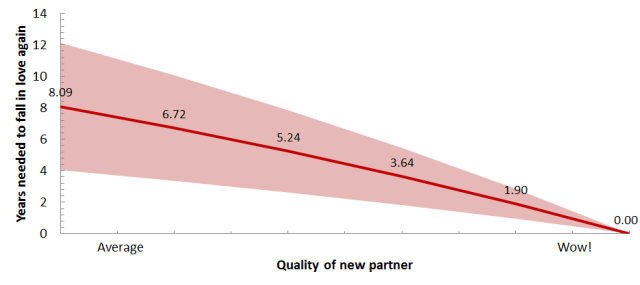
I wanted to include the possibility that, given the right circumstances, you may fall in love again immediately. I’ve encapsulated this by considering the varying quality of the new partner, which is considered to be a log scale (like the “Years together”). Here is a sample output for someone who was in a 10 year relationship, this person was in total control of the break up (0) , but not sleeping (distractions 0), and s/he felt in total control of the break up (0). So to fall in love with a decent person would take approximately two to three years.
Pinch of salt!
Please note that this is a bit of fun. In reality, moving on is about so much more than I can include here, and each relationship is unique, and requires a different amount of time to process and move on. But for some fun – have a go here!







 Tamsin E. Lee