
Below is a post written by Shweta Sharma, a Masters student from May 2020 to July 2021 whom I supervised at the Swiss Tropical and Public Health Institute.
Take it away Shweta!
It’s spring of 2020, and I am starting my masters thesis under the Disease Modelling Research Unit at Swiss TPH. Everyone is talking about COVID-19, but I will be talking about malaria! With Tamsin, I will investigate drug resistant malaria in India.
It seemed like a perfect and easy topic for me. I am from India and being with a medical background, it would be is easy for me to understand everything.
But… there is much more. There is geography, mathematical modelling, and coding.
“It’s easier to resist at the beginning than at the end.” – Leonardo da Vinci
Malaria parasites develop mutations that lead to resistance to antimalarials. India treats malaria with Artemisinin plus Sulfadoxine-Pyremethamine (SP), which requires the parasite (Plasmodium falciparum) to develop at least five mutations before the drug is no longer effective. The World-Wide Antimalarial Resistance Network (WWARN) has gathered 652,83 samples from 180 publications from 62 countries to map where SP drug resistant mutations have been detected. I used their data for India for my thesis.
Not all states in India have data on SP drug resistance. So, we consider factors that are associated with antimalarial drug resistance, and make predictions for the states without data (using regression analysis). See the map below, which goes from partially coloured to completely coloured.
From countless to countable
There are countless factors associated for drug resistance (predictor variables). To make an initial selection of ‘predictor variables’, I read. A lot. (I love doing literature reviews. You read and learn, read and learn). I learnt that socioeconomic factors are a big driver of drug resistance in India. For example in rural areas, Unlicensed Medical Practitioners (UMP) are preferred for seeking treatment and they do not follow the national malaria treatment guidelines. I settled on 44 predictor variables that covered socioeconomic factors, epidemiological factors and health infrastructure. I collected data for these variables, at the state level, from different official sources in India.
To choose which of these 44 predictor variables are the most relevant, I used combinations of two or three predictor variables in a regression model to predict the presence of drug resistant malaria for states where we know the level of drug resistance. And as a control model, I also used random values as predictor variables (the null model). The combination of predictor variables that gives predictions that most closely match the actual data are the winners.
States with low socioeconomic status are more likely to have drug resistant malaria
The three most accurate combinations were, in order:
1. Average population per government hospital and per capita income
2. Average population per government hospital and gross enrolment ratio (Gross enrolment ratio is the ratio of enrolment in higher education to the population in the specific age group. In the data I used the age group between 18 to 23 years for both genders.)
3. Average population per government hospital and the percentage of the population that lives in a rural area.
Average population per government hospital is very important as rural and urban areas have disparity in terms of the quality of health care services. Rural health centres are overburdened resulting in compromised quality of care. Combining this variable with a socioeconomic factor, makes the predictions more accurate than using the average population per government hospital as the only predictor.
From data to predictions
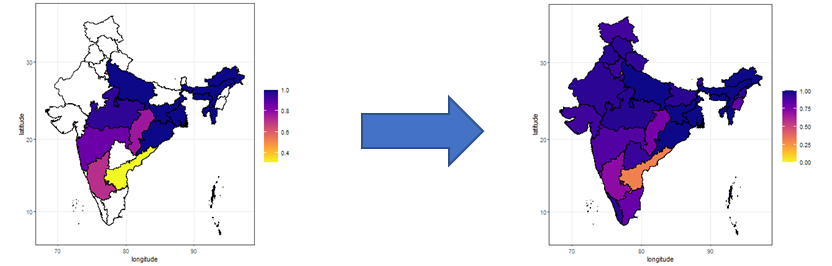
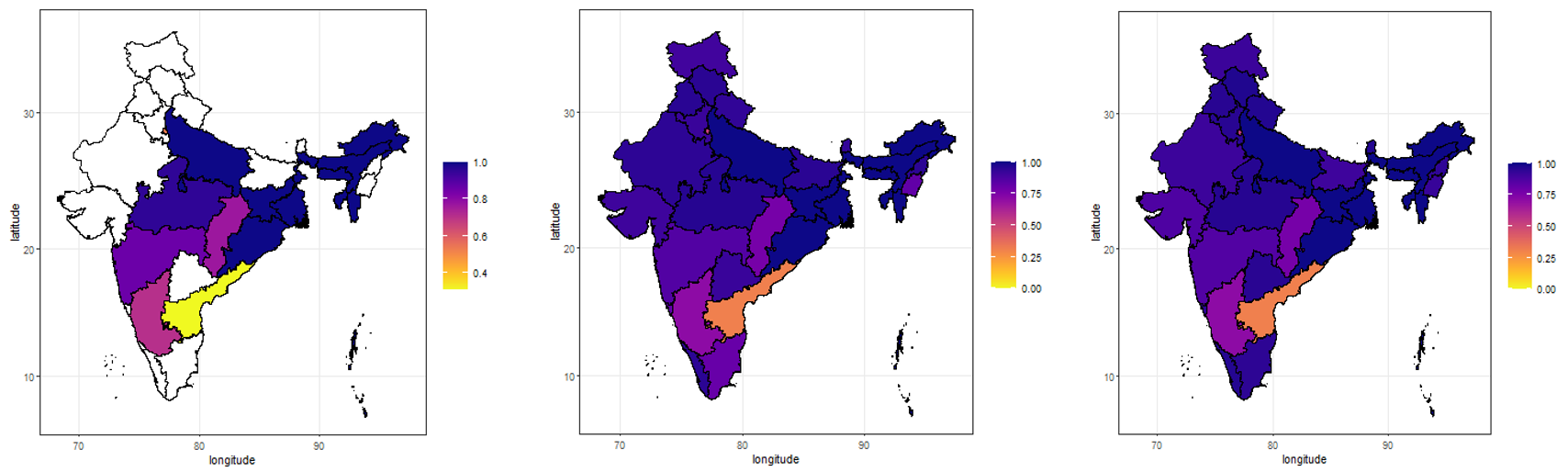
The predictions don’t match the data exactly, clearly seen with Andhra Pradesh state (yellow on left map). However, the predictions are overall very close to the data, and we can fill in information where we don’t have data.
What I learnt
Thesis – I completed my master’s thesis and learnt that socioeconomic factors are predictors of the presence of drug resistant malaria.
Geography – Now I can spot all Indian states on a map 😛
Maths – I can understand big equations better.
Coding – I can make pretty maps in R.
Tamsin, I will be grateful always for what I have learnt from you…you are an amazing person and a great mentor !


 Tamsin E. Lee