
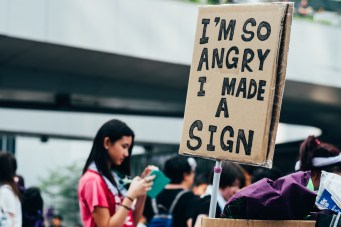
Let’s get angry! The world has many things wrong with it, and often we’re so moved that we make a placard and hit the streets. And protests have proven to be very effective, from Gandhi’s salt march in 1930, to Bolivia ensuring that The Simpsons time slot on TV didn’t change.
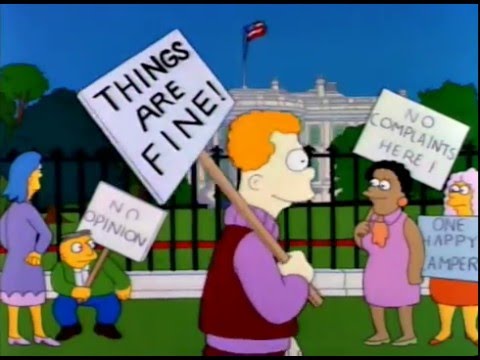
 Whilst a protest about The Simpsons is unlikely to cause a counter protest, where large numbers of people insist that the Simpsons time slot is changed, other issues are more divisive. And in fact, politicians have a strategic incentive to engage in ‘divisive politics’. So there is often a split into two angry fractions: the English Defence League versus Unite Against Fascism, pro-choice versus pro-life, or simply “Protest versus opponent”. With more passion than two competing sports teams, but considerably fewer rules, protests and counter-protests can be dangerous. They require more policing than a united demonstration of an equivalent size. However, what is the best strategy for police to keep these two opposing groups apart?
This question was raised when I was working at The Mathematical Institute, University of Oxford. There was a workshop about mathematically modelling security, and someone significant in the police force (very unfortunately I can’t remember his name nor title), mentioned that this relatively new phenomenon is a challenge for them. So I made a simple agent based model using NetLogo to start answering this question.
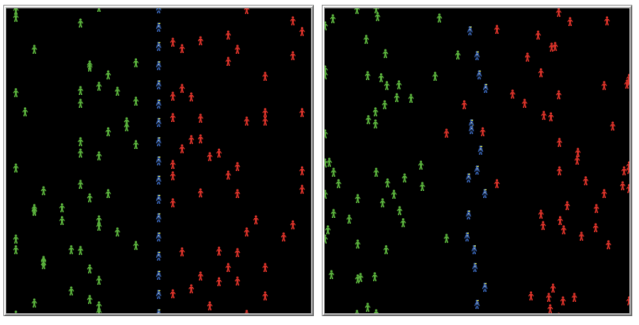
I like NetLogo because it’s easy to use, and it’s pretty! It’s nice to watch little 80s style graphics moving around in the name of science 🙂
Netlogo allows you to create ‘agents’, where each agent has it’s own set of rules. For this model, the agents are people. As with any mathematical model, especially ones modelling a new situation, there are many simplifying assumptions. I had two sides of people, red and green. The green people wanted to get on the red side, and vica versa. The thing separating them was a line of blue people, the police. Further details about the rules for each agent are described in the paper, published in the Journal of Artificial Societies and Social Simulation.
What the model shows is that police are best able to keep the two sides separate by forming a human barrier, which works well, even with few police. According to the model, it is more effective if police are not distracted by other protesters, but simply remain as one thin, solid, blue line. However, it should be noted that I have not included violence in this model. Nor have I included protesters interacting with each other.
The model is a long way from being realistic. However, with some input from experts on protesting social behaviour, it could be more powerful. For example, previous work on protesters (which exclude counter protesters) include interactions between protesters and police using game theory. It would be interesting to do something similar, where there are positive and negative interactions among protesters. Perhaps include the influence of ‘mob mentality’, and perhaps a desire to appear on the ‘right side’, by not rising to antagonising behviour. With clear communication between mathematicians and social scientists, these rules can be added, and then one simply sits back and watches the little coloured graphics dance around the computer screen 🙂
The paper is here. The NetLogo code is here.


 Tamsin E. Lee